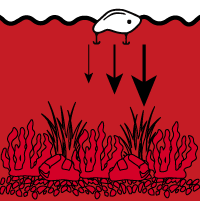
Lure Sink Classification is a rating provided for many types of treble hook lures and for some molded/rigged soft baits. Sink classification is also called “Class” or “Style” or “Sink Speed” which describes lure’s descent rate based more on the lure buoyancy and not the lure’s weight.
Why are SInk Classifications Important?
Sink Classifications are important to:
Understand Lure’s Descent Rate: Often treble hook lures and some molded soft baits lures have buoyancy and thus the lure’s weight does not provide guidance to the lure’s descent rate. As such, manufacturers put fall rate labels on the lure packages with fall rate classifications.
Vertical Descent of a Horizontal Presentation Lure: Sinking lures of any sink classification can provide a slow vertical lure action that some suggest can be effective.
Sink Classification Options
Floating: Floating can mean it floats with no retrieve but once a retrieve commences can be very shallow, 1 ft to 3ft.
Surface Contact Lures: Top water lures, lures that float, generally always float, independent of the retrieve and may or may not have an official sink classification – floating.
Suspended: These lures often come with a depth rating that they will stay when retrieved including when the retrieve is stopped/paused.
Sinking: Means the lure will sink at a slow rate with no retrieve.
Slow Sinking: Generally, means the same as sinking,
Medium – Slow Sinking: Generally, it will sink at a faster than the slow rating.
Medium (Moderate): Generally, means it will sink at a medium rate.
Fast Sink: Less common, means the lure will sink quickly.
Additional Considerations
No Classification/Style/Sink Speed: Lure that do not provide descent rating use:
Depth Rating: Some lures, for example lipped crankbaits and hard jerkbait, provide specific depth they will reach to be used as the strike zone. Often these lures will float without a retrieve.
Lure’s Weight: Lures that have no buoyancy or rigged the lure’s weight provides insight into the lure’s descent rate.
Manufacture Rating System: There is no cross industry standard as such it can be challenging to compare descent rates based on rating from one manufacturer’s lure to another.
Rate of Fall – ROF: Rate of fall is the number of feet in 10 seconds. For example, ROF 0 is floating and a ROF 5 means fall rate of 5 ft in 10 seconds. ROF is also an indicator of how easy to keep the lure on the bottom or other strike zones.
Unpackaged Lure: To classify an unpackaged lure, place it in the water with a net or where you can reach the bottom. If it sinks, tie it to a rod and count it down to the bottom. If it doesn’t sink, retrieve it in shallow water with no cover to see when it hits bottom.
It's About the ALLURE™
Surface Contact Lures that Commonly have Sink Classifications